Baggage fieldnotes / 01 / Behind the belt
What happens after your bag disappears?
A suitcase leaves the check-in desk. What follows is not one machine, but a chain of readings, routes and carefully timed handoffs. Follow the bag through the parts of the airport you rarely see.
Trace the baggage journey01 / From acceptance to aircraft
Follow one suitcase
This is a representative outbound journey, not a map of a particular airport. Security rules, terminal design and airline procedures change the sequence.
Accepted, labelled, associated
The airline accepts the bag and issues a tag. Its identifier connects the physical suitcase to a record. That association must survive every later handoff.
Read, screened, given a route
Readers capture the identifier while controls decide where the bag should go. Hold-baggage screening is a separate security process; a successful tag read does not mean security clearance.
Transported, sorted, sometimes held
Belts, trays or other carriers move the load. Sorters send it toward a flight collection point, an early-bag store or an exception station. A route can change when a flight or connection changes.
Built into a flight load
At make-up, bags are assembled into carts or unit load devices. People, lifting aids and selected robotic applications may share this work. A safe grip and a correct destination are different requirements.
Handed over at the aircraft
Ramp teams move the load to the stand and complete loading under local procedures. Later tracking events may record the transfer. The bag’s journey continues at a transfer airport or the destination reclaim belt.
02 / Four connected systems
The handoffs that matter
Start with the question that interests you. Each fieldnote explains a different layer of the same operation.
Sorting the flow
How a destination decision becomes a precisely timed physical diversion—and why robotic picking is a different task.
Read the sorting fieldnote → 02 / IdentificationReading the tag
Barcodes, RFID and the evidence behind a baggage status. Learn what a read proves, and what it cannot.
Read the tracking fieldnote → 03 / TransportMoving the load
Belts, tray systems, sensors and buffers turn a collection of moving parts into a controlled transport network.
Read the conveyor fieldnote → 04 / CoordinationCoordinating the apron
Flight deadlines, staff, stands and equipment all have to agree. Automation cannot plan away every late change.
Read the operations fieldnote →03 / Look closer
Inside the machinery
The important detail is often an interface: the gap between belts, a reader’s field of view, or the contact point between a gripper and a soft bag.
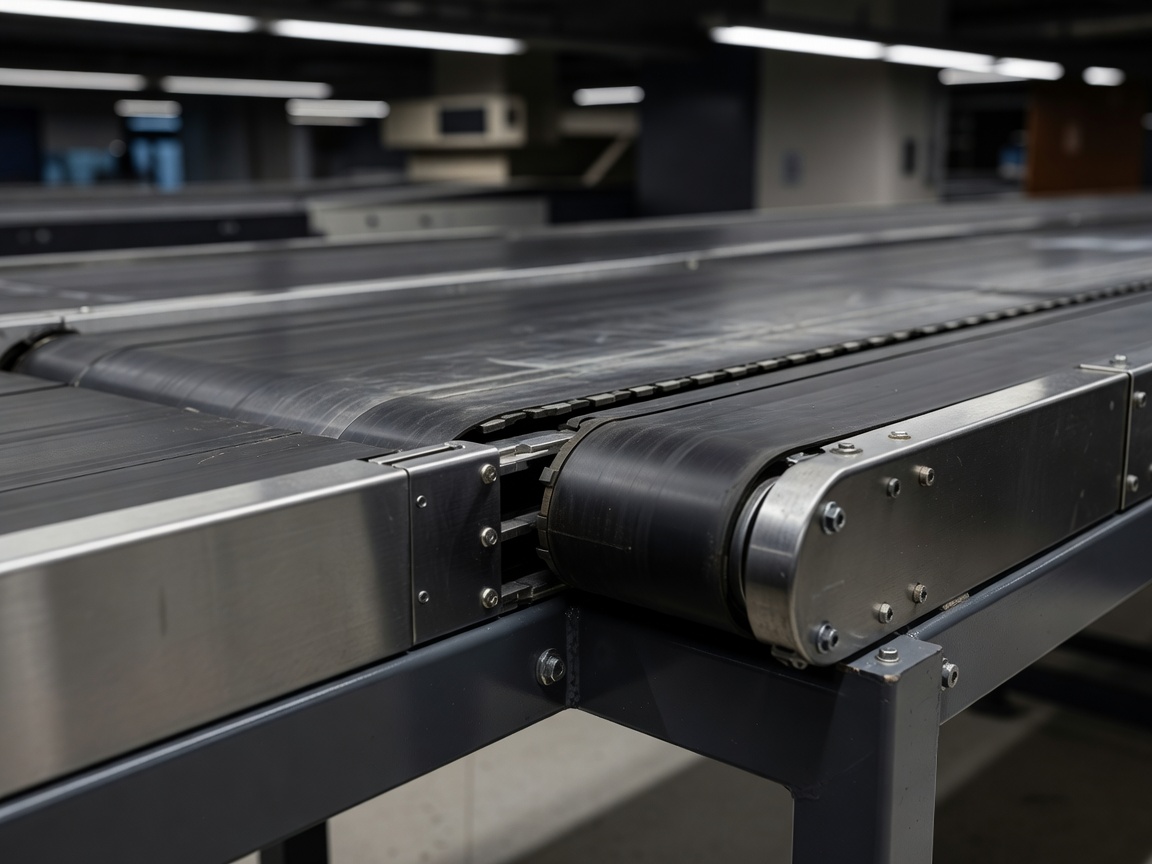
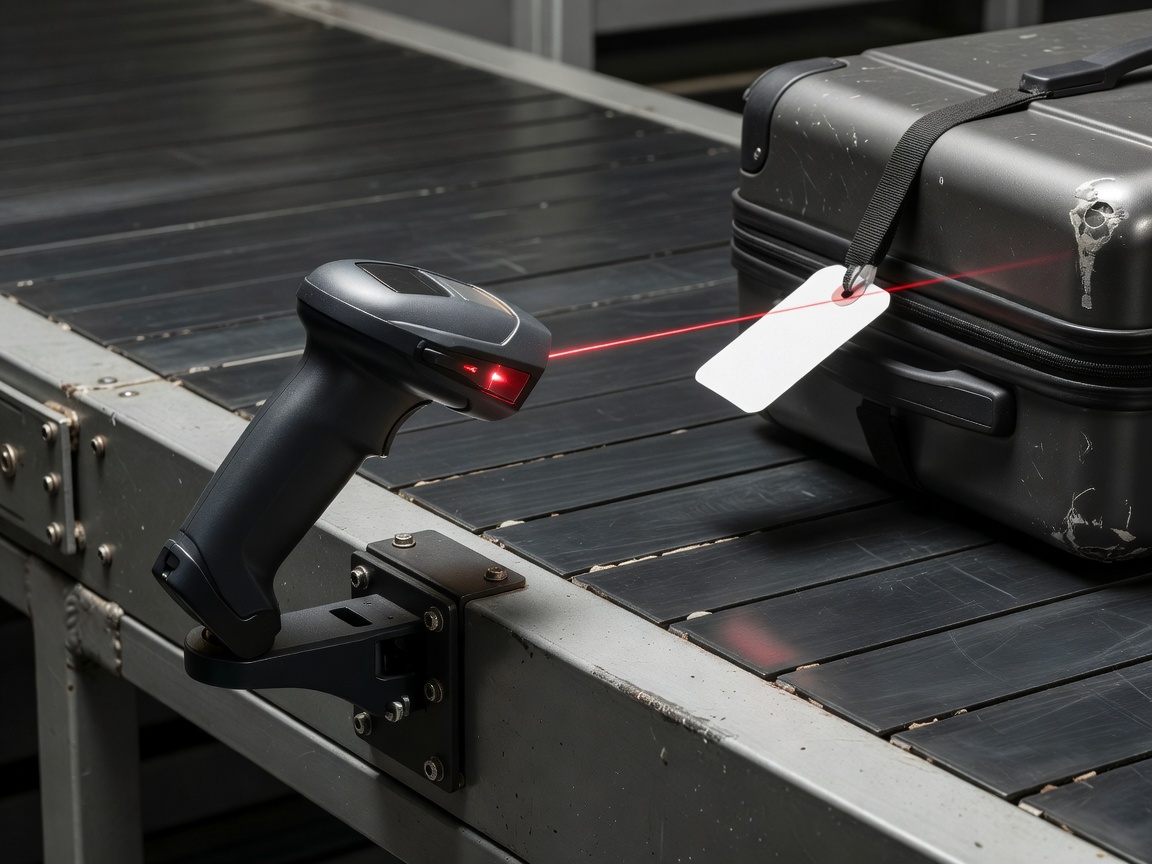
Conceptual annotation only. These photographs do not establish which control system or operating procedure a particular airport uses.
04 / Evidence before certainty
Signals, not guesses
A tracking event is a statement about a recorded observation. It may describe a scan at a location, an association with a container or a handover between operators. It is not necessarily a continuous position fix.
“Read successfully” and “loaded successfully” answer different questions.
We separate the physical movement, the software decision and the evidence recorded afterwards. That distinction makes both robotics claims and passenger updates easier to interpret.
Understand the evidence behind a tracking event →05 / The exception path
Where automation hesitates
A loose strap catches at a transfer. A damaged tag cannot be read. An unusually shaped item does not fit the normal route. A stand changes after the load has been prepared.
These are not interchangeable failures. Some require a new destination; others need physical handling or a security-controlled decision. Good automation includes safe stops, clear exception queues and people with the information and authority to recover the flow.
06 / Start here
Questions from the reclaim belt
Is every airport baggage system robotic?
No. Many systems automate transport and routing without using robotic arms or autonomous vehicles. Human handling remains important at several interfaces.
Does a tracking update mean my bag is on the aircraft?
Only an event explicitly describing a loading action supports that interpretation, and even then the airline’s event definitions matter. A check-in or sorting scan is not a loading confirmation.
Why can an unreadable tag delay a bag?
The system needs a reliable association between the bag and its record. An unreadable tag may send it to an exception station for identification and routing.
07 / The fieldnote method
Read the operation closely
Showwondergadget is an independent editorial website, not an airport, airline or baggage-tracing service. We use standards bodies, industry guidance and clearly identified equipment descriptions to explain mechanisms without treating vendor capability as universal deployment.
- IATA baggage resources — industry context, tracking initiatives and operational guidance.
- ICAO aviation security resources — the wider security framework, distinct from routine baggage routing.
- GS1 EPC/RFID standards — background on identification technology, not a claim about a specific airport installation.