A number that points to a record
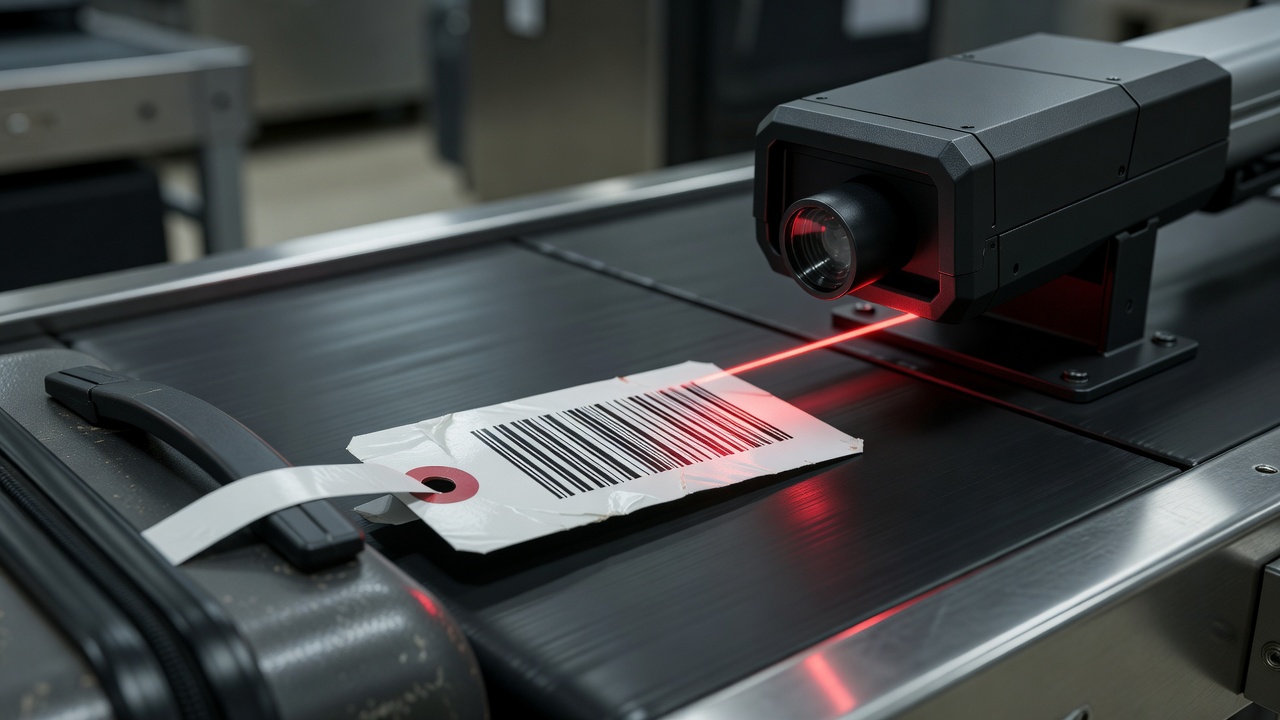
A standard interline baggage tag commonly carries a ten-digit identifier known as the licence plate. Its purpose is to identify the bag within the baggage-processing environment. The printed itinerary information helps people, while the machine-readable identifier supports automatic processing. The identifier is not, by itself, the full current operational record.
Behind a read, airline and airport systems may exchange messages describing the bag, its intended flight and its status. Systems must associate those messages with the right physical item. A correctly printed tag does not guarantee that every receiving system has timely, consistent information, especially when a passenger is rerouted or a connection changes.
Two ways to capture an identity
Optical barcode readers need a usable view of the printed code. Reader arrays can observe several sides of a bag, but folded labels, damage, poor contrast or obstructed presentation can still create a no-read. A person may then inspect the tag, enter information or issue a replacement under the relevant operating procedure.
Radio-frequency identification, or RFID, uses radio communication with a tag rather than relying on an optical view of printed bars. That can improve identification opportunities in suitable installations. It does not mean every bag can be read anywhere: antenna placement, interference, tag condition and the surrounding materials still affect the reading environment.
- Identification
- Establishing which bag record belongs to the item being observed.
- Tracking event
- A recorded observation or handover associated with an identifier, a time and an operational context.
- Passenger status
- A simplified view derived from operational information. Its wording and update timing depend on the airline or service.
What IATA Resolution 753 asks for
IATA Resolution 753 establishes baggage-tracking obligations for member airlines at four core points: acceptance, loading, transfer and arrival. It concerns recording and sharing tracking information in the airline baggage process. It should not be read as a promise that every airport exposes every internal scan directly to a passenger.
The practical event may be collected through different technologies and workflows. Understanding whether a record refers to an individual bag, a container association or a particular custody change matters. The existence of an industry requirement does not prove that a named operation meets it in every circumstance; that needs deployment-specific evidence.
A scan tells you what was observed at a defined interface. It does not fill in every metre between interfaces.
When the digital story has gaps
A missing update can have several explanations. The physical bag may have moved without an expected read. A message may be delayed. A record may exist inside one operator’s system but not yet appear in the passenger interface. Or the bag may genuinely have missed the intended movement. An empty screen alone cannot distinguish these cases.
Conversely, a status can be accurate when recorded and become incomplete after a later change. A bag staged for a flight could need removal or reassignment. A useful investigation therefore checks event definitions, timestamps, location references and the sequence of later actions rather than treating one reassuring label as the final truth.
| Signal | Useful interpretation | Do not assume |
|---|---|---|
| Check-in acceptance | The bag entered the acceptance process | It has reached the aircraft |
| Sorter identification | An identifier was captured at that interface | The downstream diversion succeeded |
| Loading event | A loading action was recorded under the operator’s definition | No later unloading or reassignment occurred |
| Personal tracker position | A consumer device reported an estimated location | It is an official custody or security record |
Keep personal tracking in perspective
A consumer tracking device can provide an additional clue, but it operates outside the airport’s formal baggage record. Updates may depend on nearby compatible devices or network conditions. Location accuracy and reporting delay vary. Follow airline and aviation rules for electronic devices, and do not use a tracker indication as permission to enter restricted areas.
If a bag does not arrive, report it through the airline’s official baggage channel and retain your receipt and reference number. This website cannot access airline tracing systems. Avoid publishing a full baggage tag or boarding pass: their identifiers and printed details may reveal information about your journey.