Start with the destination, not the robot
A sorting system does not simply recognise a suitcase and guess its flight. It normally receives or retrieves routing information associated with the bag’s identifier. The intended destination may be a flight make-up position, a storage location, a transfer route or an exception station. That destination can depend on the departure schedule, the bag’s status and which downstream facilities are available.
The physical system must then maintain an association between the identified bag and its movement through the network. Sensors, conveyor zones or individual carriers help control systems follow that association. If two bags become too close, or an item shifts unexpectedly, the system may lose confidence in which record belongs to which load. Correct identification upstream is therefore necessary, but not sufficient, for correct sorting downstream.
A diversion is a timed handoff
Different sorter designs use different mechanical actions. A diverter can steer a load toward a branch conveyor. A tilt-tray sorter changes a tray’s angle to discharge its load. A cross-belt carrier uses its own small belt to move a bag sideways. These are examples of mechanisms, not a claim that all airports use them or that they are interchangeable.
Each mechanism has an operating envelope. Bag dimensions, weight, orientation, spacing and surface condition influence whether a transfer can occur reliably. The receiving chute or conveyor must also be ready. A sorter that can discharge quickly offers little benefit if the destination is blocked and the system has nowhere safe to send the next load.
Sorting is not the same as robotic loading
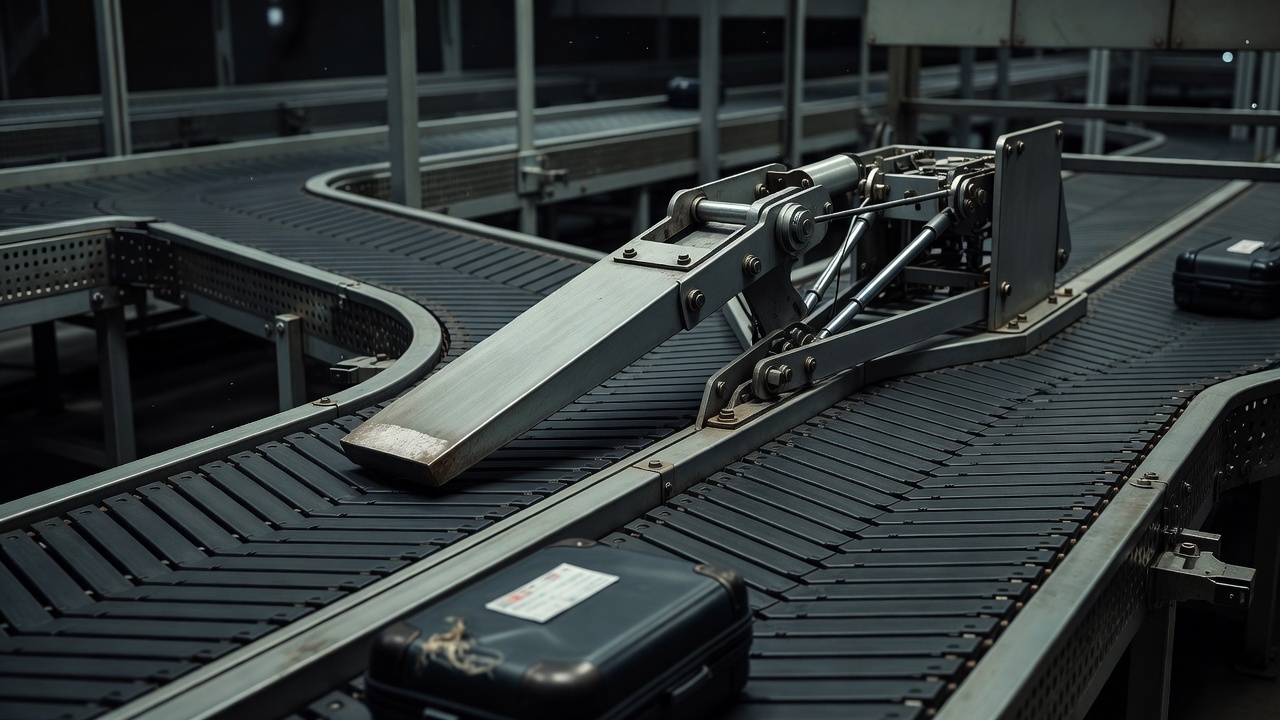
A robotic arm that picks bags from a belt faces a different problem. It needs to estimate the object’s position, choose a feasible contact or grasp, lift within safe limits and place the item where required. A rigid suitcase, a soft duffel and an item with loose straps can behave differently even when their external dimensions appear similar.
Vision and force sensing can help a robot adapt, but they do not remove the need for bounded conditions. A deployment may require controlled bag presentation, restrictions on unusual items or an operator available for recovery. Ask what proportion of the incoming bag mix the application is intended to handle, rather than assuming a successful demonstration represents an entire shift.
The useful question is not “Can it pick a suitcase?” but “Which suitcases, under which conditions, with what recovery path?”
Give exceptions their own route
An unreadable tag, an oversized bag and a mechanically obstructed bag should not all enter the same undifferentiated queue. Their recovery tasks are different. One may need a new identifier association; another may need a separate transport route; a third may require a controlled stop and safe access to equipment.
Operators need clear information about why an item was rejected. Repeatedly recirculating a bag without changing its condition consumes capacity and can make a peak period harder to manage. A well-designed exception process records the intervention and returns the bag to an appropriate point without silently bypassing security or reconciliation requirements.
| Layer | Primary question | Useful evidence |
|---|---|---|
| Route assignment | Where should this bag go now? | Current destination and status record |
| Physical sortation | Can this item transfer safely? | Spacing, position and downstream availability |
| Robotic handling | Can this load be picked and placed? | Pose, contact, load limits and recovery outcome |
Read performance claims carefully
A quoted bags-per-hour figure may describe a machine’s nominal capability, a tested configuration or an observed operational result. Those are not the same measurement. Compare the bag mix, exception rate, staffing assumptions, downtime definition and upstream feed conditions before comparing two figures. A high peak rate also says little about recovery after a disruption.
At airport scale, sorting quality belongs to the whole chain. The best diverter cannot correct stale flight information, and the most capable gripper cannot clear a blocked outbound lane. Meaningful evaluation follows the bag from identification to confirmed destination, including the cases that need a person.